

Prologue
Something is happening in the AI consumer space that I think deserves more attention than it’s getting. It’s not about a single product launch or a benchmark score. It’s about a structural shift in how consumers interact with software — and, potentially, in how the entire consumer internet gets reorganized.
I’ve been spending the past several weeks thinking through what it means, and I wanted to share some observations and a developing framework. I don’t claim to have all the answers — this is very much a work in progress — but I believe the pattern is significant enough to put out there and invite conversation.
Let me start with what triggered this line of thinking.
I. What’s Happening: Coding Agents Cross a Tipping Point
Coding agents have gotten powerful. That’s not news. But the degree of improvement we’ve seen in recent months has been, I think, genuinely underappreciated.
With the latest generation of frontier models and the maturation of agentic coding tools, we’ve crossed what feels like a meaningful threshold. Coding agents are no longer generating toy apps or stitching together fragile prototypes. They are building real software — CUDA-compatible packages for AMD, C compilers, complex full-stack applications like Claude Cowork — often in a single shot, without human intervention.
The term “vibe coding” was coined to capture a certain playful, experimental spirit of AI-assisted development. I’d argue the “vibe” part no longer applies. What these agents produce is production-grade. And if you extrapolate even modestly — as Elon Musk has suggested — you can envision a near future where coding agents bypass high-level languages entirely and generate executable binaries directly.
That, by itself, is a fascinating development for the developer ecosystem. But the thing that caught my attention is what OpenClaw represents.
OpenClaw takes this coding agent capability and wraps it in a conversational interface that anyone can use. It connects to messaging platforms consumers already live in. It runs continuously. It supports a growing ecosystem of community-created Skills. And it’s model-agnostic — working across frontier models from multiple providers.
Here’s what I find most notable: OpenClaw isn’t a developer tool. It’s a consumer agent. A non-technical user can, through ordinary conversation, instruct it to automate workflows, manage schedules, track expenses — and, critically, create entirely new software functions on the fly to fulfill whatever the user needs.
Think about what that means. Two capabilities that have historically existed in completely separate worlds are converging into a single interface:
Conversational AI (the ChatGPT paradigm — analysis, writing, Q&A)
Agentic code execution (the Claude Code paradigm — building and running software)
When you merge these two in a consumer-facing wrapper, you get something qualitatively new:
Full-fledged software creation capability, combined with concierge-level coordination, delivered directly to everyday users.
I would be calling this emerging world the Clawverse — not because OpenClaw is the winner (it may not be), but because it is one of the clearest early signals of where we’re heading.
II. OpenClaw, A New Architecture for “AI Concierge”
When I look at OpenClaw (and the architectures it represents), I don’t see “a better chatbot” or “another AI wrapper.” I see the emergence of what might be described as an AI Concierge — a persistent, intelligent layer that positions itself between the user and the entirety of the digital services landscape.
The structure matters. The AI Concierge serves as a central hub that performs three distinct functions:
1. Intent Capture
The concierge becomes the first place the user’s intention lands. Whether someone wants to book a trip, compare insurance options, track a package, or build a custom analytics dashboard — the intent is expressed to the concierge first. It acts as the portal reading all of the user’s intent — triaging what the user wants and deciding how to route it.
This is meaningfully different from how intent has historically been captured. A user’s intent has historically been captured as the best available approximation by analyzing signals of “user attention”—including website visits, clicks, dwell time, and search queries—within what has been termed the “Attention Economy.”
The concierge consolidates this by directly capturing the user’s intent.
2. Execution Coordination
Once it understands the intent, the concierge decides how to fulfill it. This is where it gets interesting. It can:
Call an external service or API
Invoke a pre-built Skill from the community ecosystem
Chain multiple tools together
Or — the genuinely novel part — generate a new function on the spot by writing and executing code
As Tom Tunguz captures this dynamic well: “Skills are programs written in English. They tell an agent how to accomplish a task: which APIs to call, what format to use, how to handle edge cases. A skill transforms an agent from a conversationalist into an operator.”
The concierge doesn’t just talk. It does.
3. Personalization & Memory
This is perhaps the most strategically consequential function, and the one I think is most underestimated. Every interaction — every decision, preference, transaction, and outcome — accumulates as a persistent data layer. Payment methods, shipping addresses, dietary restrictions, communication preferences, past transaction records and results.
Still limited today, but the future trajectory is clear: the concierge progressively becomes the repository of personalization data — not just what you asked for, but what you chose, what you rejected, and what worked.
The Strategic Implication
When you put these three functions together — intent capture, execution coordination, and personalization accumulation — the concierge begins to look like something quite powerful: the entity that controls the most value capture in the user’s digital life.
I’m not making a prediction that any single product will achieve this position. But architecturally, the pattern seems clear: an AI assistant that can read your intent, coordinate (or create) the capability to fulfill it, and learn from the outcome positions itself as the central hub of the consumer digital experience.
From the user’s perspective, the consequence is straightforward: why would I go looking for a specific app when the concierge already understands what I want and can either find or build the solution?
III. The “Death of Apps” — Or Rather, Their Reassembly
I want to resist the clickbait framing here. Apps aren’t going to vanish overnight. But I do think the concept of the app as the primary unit of consumer software is being structurally challenged in ways that are worth examining.
What Apps Actually Were
To see why, it helps to step back and think about what an “app” has always been: a bundled package of specific functionality and UX, designed to standardize a workflow in a particular domain. Order food. Edit photos. Manage email. Track fitness.
This bundling was a solution to a real problem. Users got efficiency and learnability. But the trade-off was: personalization was sacrificed for standardization, and user data became siloed inside each app. Your social graph lives in Instagram. Your purchase history lives in Amazon. Your learning progress lives in Duolingo. These data silos became the foundations of moats — lock-in, network effects, system-of-record gravity.
The UX Arc That Got Us Here
It’s worth tracing the evolution historically:
PC era: The desktop metaphor. Files and folders were the primary objects; applications were tools you applied to those files.
Web/Mobile era: Files disappeared. Apps became the first-class entities. Data moved inside each app and became invisible to users — siloed, proprietary, non-portable. Your phone became a grid of icons, each containing a walled garden of functionality and data.
This represented a reasonable equilibrium, as it freed users from having to build custom software to meet these needs, while requiring trade-offs in data portability and UX personalization.
But it was an equilibrium built on a specific constraint: the user had to find, download, learn, and manage each app individually. The app was the best available packaging unit for delivering digital value to consumers.
What Changes in the Clawverse
In a world where an AI Concierge can interpret your intent, assemble capabilities dynamically (through pre-built Skills, Plugins, or on-demand code generation), and access your personalization data in a portable layer — the app bundle may no longer be the optimal packaging unit.
The “death of apps” is less about software disappearing and more about the packaging unit of software value changing. A consumer might still use Uber (the service), but not “open Uber” (the app) as often. They might still pay for Spotify (the catalog + rights + recommendations), but discover and play through the concierge. The assistant becomes the default beginning of work.
IV. A New Architecture to Deliver “Consumer Intent”
If the app bundle is being pulled apart, what are the constituent pieces? This is where I’ve found it useful to think about a simple decomposition.
When you strip a consumer app down to its essentials, you get three components:
1. Intent Capture
How does the system learn what the user wants?
Directly — through conversational UX, guided flows, dashboards
Indirectly — through search/SEO (Google has historically monetized through the capture of user intent with the search keywords as its approximation.)
2. Delivery (Execution)
The actual work: purchasing, booking, scheduling, analyzing, messaging, paying. This is the core function of the app — the thing it does.
3. State & Memory
This is where things get nuanced. There are several layers of “state” that apps accumulate:
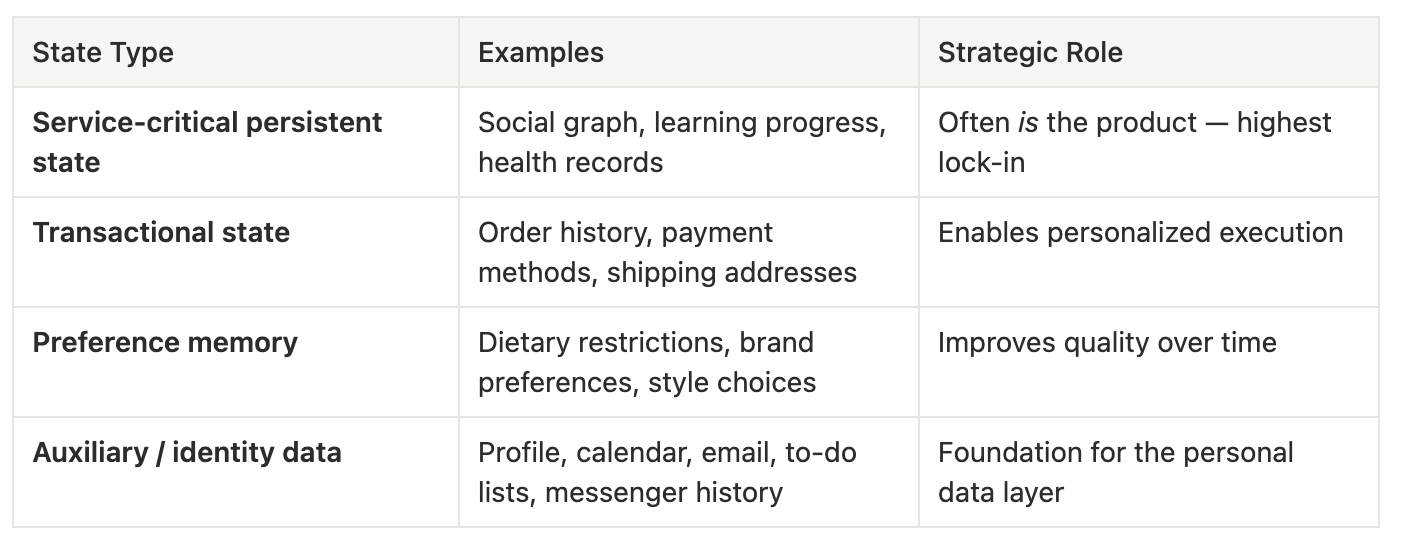
The key insight from this decomposition: different consumer services are defended by different types of state.
Transactional services — e-commerce, food delivery, travel booking — have relatively shallow state requirements. If a concierge can capture intent, compare options, and execute with your stored preferences, the branded app experience becomes… optional. The competitive axis shifts from “best app UX” to best supply, best price, fastest fulfillment.
Persistent-state services — social networks, education, therapy, long-running creative tools — are harder to disintermediate because the state is the product. Your social graph, your learning trajectory, your therapeutic history. These moats are deeper.
But here’s the question that keeps nagging at me: what happens when that state becomes portable? When a user can export their social graph, their learning progress, their preference history — and bring it to a new interface assembled by a concierge?
If state becomes portable, then even deep moats start to weaken. And the defensible asset shifts from “I hold your data” to “I consistently deliver the best outcome.”
I don’t think we’re there yet. But I think the direction is worth watching carefully.
V. Where the Moat Moves
If the above decomposition is directionally correct, it suggests some shifts in what “winning” means for consumer AI products — and I’ll share my current thinking, though I’d have to admit these are hypotheses, not conclusions.
The premium interface becomes intent-first. Historically, consumer products differentiated through UI polish, onboarding, and habit loops. In an intent-first world, the interface becomes less “screens you navigate” and more “intent you express,” plus a thin layer of confirmation and transparency. UX becomes more important, not less — but the target changes from feature discoverability to outcome reliability.
The moat may shift from UI to state + trust + access. If the concierge can route to multiple providers, then “being the front-end” alone is less defensible. Potential moats shift toward:
State: depth and portability of personalization and history
Trust: guarantees, safety, compliance, dispute resolution
Access: exclusive supply, proprietary data rights, privileged integrations
Consumer AI winners may be the ones who combine execution quality with trusted custody of state, rather than simply shipping another beautiful app.
Disruption will come at different speeds. Transactional services face earlier exposure. Persistent-state services get disrupted differently, and potentially later. The key variable in both cases is state portability — the degree to which identity and context can move with the user rather than remaining captive to a single provider.
VI. A Closing Thought: From Attention to Intent
For the last twenty years, consumer internet economics have run on the Attention Economy: capture eyeballs, approximate intent from behavior, monetize through ads, ranking, or conversion.
In the Clawverse, the assistant can capture intent directly: “Find a flight.” “Order dinner.” “Plan my week.” “Help me learn this concept.” “Talk me through this decision.”
When intent is explicit, the economic locus shifts:
The system that captures intent becomes the new distribution layer.
This is why consumer AI assistants are not merely a product category — they are potentially a new platform layer. But I want to be careful: I don’t think we should assume a single “winner assistant.” Open-source approaches, model-agnostic architectures, and consumer preferences around privacy could lead to a more fragmented landscape than the mobile app era.
So my working questions are less “who wins?” and more:
Where does intent land first?
Where does state live?
Who is trusted to execute?
What becomes scarce when software is abundant?
The economics of the Intent Economy are still forming. And I’d genuinely love to hear how others are thinking about these dynamics — especially those who are building consumer products at the frontier, or who think this entire Clawverse framing is directionally wrong. The best insights on emerging platform shifts have always come from practitioners, and I’d welcome any thoughts, pushback, or pattern-matching you’re willing to share.
There will be Part II, which would look into what might happen in the near future with respect to a few keywords on the changes in the Consumer UX.
Persistent-state services - What happens when that state becomes portable?
I think for many of these state-driven services, both UX and state are the product (e.g., SNS provides a specific interface pattern (e.g., infinite scroll) for users to consume the state they own), and integrating the execution into the consierge interface is possible but would most likely provide a suboptimal experience. I imagine a pattern in which a user expresses an intent, launches a service to fulfill it, and then returns to the concierge for the next to-do.
With that, what would motivate these services to expose their internal state voluntarily? Without state sharing, the above UX pattern provides little value; the concierge is merely an app launcher. Exporting data from service -> consierge makes sense from the user's perspective; however, I can't think of a compelling reason yet why services would want to willingly give up their moat - unless it enables/gives them a competitive advantage. I guess enabling this UX pattern by sharing state makes the service more appealing from the concierge ecosystem's point of view; they might need it just to be discoverable (similar to SEO/ASO).
Curious to hear what you think.